
The modern internet is powered by countless programming languages, but few are as versatile and beginner-friendly as Python.
Behind platforms like Instagram, Pinterest, Spotify, Dropbox, and Reddit lies the power of Python — quietly running complex processes, handling millions of users, and supporting global digital ecosystems. Python has risen to become one of the most popular languages for web development because it blends simplicity, flexibility, and incredible power. Whether you’re building a small website, an API, or an enterprise-level application, Python gives you all the tools you need.
What is Web Development with Python?
Web development with Python refers to using Python’s frameworks, libraries, and tools to build dynamic and interactive websites or web applications.
Python isn’t used in the browser like JavaScript. Instead, it powers the backend — the part of a website that handles logic, authentication, databases, servers, and security.
Python offers several powerful frameworks, each designed for different needs:
🔹 Django — “The all-in-one powerhouse”
- Batteries-included framework
- Comes with authentication, admin panels, ORM, forms, routing, and security built-in
- Great for enterprise-level applications
🔹 Flask — “The minimalist, flexible option”
- Lightweight
- Gives you freedom to structure your project the way you want
- Perfect for small apps, APIs, prototypes, and highly customized applications
🔹 FastAPI — “The modern API king”
- Extremely fast (comparable to Node.js and Go)
- Perfect for data-driven apps and machine-learning integrations
- Automatic documentation with Swagger UI
🔹 Pyramid, Tornado & Web2Py
These are lesser-known but powerful frameworks, used for specific large-scale use cases. With these tools, developers can build blogs, e-commerce platforms, dashboards, social media websites, AI-powered apps, fintech systems, and more.
How Does Python Build Websites?
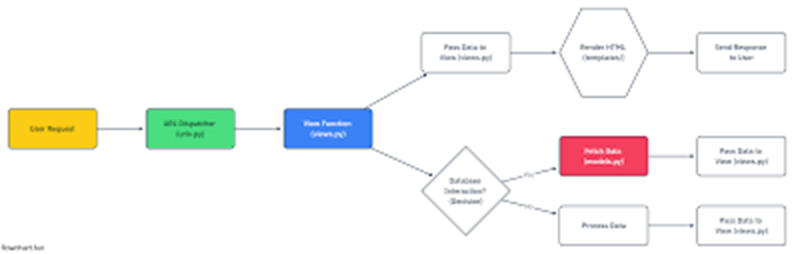
Python connects the front-end (what the users see) with the back-end (what controls the logic and database). Here’s how it works:
1. User sends a request
For example:
“Log me into my account.”
2. Python processes the request
The backend framework checks:
- Are the login details correct?
- Does the user exist in the database?
- What should be displayed after login?
3. Python interacts with the database
It retrieves, stores, or updates data.
4. Python sends a response
It returns the correct page, dashboard, or action to the user’s browser.
Behind every smooth, well-structured website is a backend system — and Python handles that extremely efficiently.
Why Developers Love Python for the Web

✔ Clean and Readable Syntax
Python’s language design is simple, making code easier to read and maintain.
✔ Rapid Development
Frameworks like Django allow you to build complete applications in record time.
✔ Strong Security
Django automatically protects against:
- SQL injection
- Cross-site scripting (XSS)
- Cross-site request forgery (CSRF)
- Clickjacking
Python is trusted for fintech, health, education, and government systems.
✔ Massive Community Support
Millions of developers contribute to Python libraries, tutorials, and open-source tools.
✔ Perfect for Data-Driven Web Apps
Python is the default choice when combining web development + data science + AI.
This makes it ideal for apps involving:
- Machine learning
- Data visualization
- Analytics dashboards
- Automation systems
Python vs JavaScript vs Java vs PHP vs Ruby — Which Is Better for Web Development?
Python is powerful, but how does it compare to other major web development languages?
Below is an in-depth comparison.
Python vs JavaScript (Node.js)
JavaScript rules the front-end, while Python dominates in the back-end and AI.
Python Strengths:
- Simple, readable, and beginner-friendly
- Massive ecosystem for AI/ML
- Great for rapid development
- Strong frameworks like Django & Flask
JavaScript Strengths:
- The only language that runs in the browser
- Node.js makes it full-stack
- Very fast for real-time apps (e.g., chat apps)
Who wins?
- For data-driven apps, dashboards, AI integration → Python
- For real-time apps (chat, live notifications) → JavaScript
For full-stack development alone → JavaScript, because it handles both front-end and back-end
Python vs PHP
PHP has powered the web for over 20 years (WordPress, Joomla, etc).
Python Strengths:
- Cleaner and more modern
- Stronger for AI, ML, automation
- Better structured frameworks (Django)
PHP Strengths:
- Excellent for CMS websites
- Easy hosting on almost any server
Who wins?
For modern web apps → Python
For CMS-based websites → PHP
Python vs Java
Java powers huge enterprise systems and Android apps.
Python Strengths:
- Easier to learn
- Faster development
- Better suited for startups and prototypes
Java Strengths:
- Very fast and powerful
- Excellent for large, enterprise-scale applications
- Strong type safety
Who wins?
For large banks, telecoms, and huge systems → Java
For web development, startups, innovation, and AI → Python
Python vs Ruby (Rails)
Ruby on Rails and Django are often compared.
Python Strengths:
- Bigger community
- Easier to learn
- More versatile (AI, ML, automation, data science)
Ruby Strengths:
- Rails is extremely productive
- Very elegant syntax
Who wins? Overall → Python, because of versatility and wider adoption.
Real-World Use Cases of Python in Web Development
Python powers a wide range of applications:
📌 Social Media Platforms
Instagram uses Django to handle millions of users.
📌 Streaming Services
Spotify uses Python for personalization and backend logic.
📌 E-commerce & Marketplaces
Django powers scalable and secure online stores.
📌 Financial Technology (FinTech)
Python is used for fraud detection, transaction processing, and digital banking.
📌 Machine Learning Web Apps
Python is the #1 choice for apps involving data science:
- sentiment analysis
- recommendation systems
- predictive analytics
- automation dashboards
📌 Web APIs FastAPI is now the go-to tool for high-performance API development.
Limitations of Python for Web Development
Python is great, but not perfect:
- Slower than Java or Node.js for high-concurrency apps
- Not ideal for real-time applications like games and chat apps
- Hosting can be slightly more complex than PHP
- Front-end tasks still require JavaScript
Still, Python’s advantages easily outweigh its drawbacks — especially for modern, data-oriented applications.
Final Verdict
Python is one of the most powerful and flexible languages for building modern web applications. With frameworks like Django, Flask, and FastAPI, you can build secure, scalable, and professional web systems — quickly and cleanly.
What makes Python stand out is not just simplicity, but its integration with data science, machine learning, and automation, making it the ideal choice for next-generation web applications.
If you’re dreaming of building websites, APIs, dashboards, social platforms, or AI-powered apps, Python gives you everything you need — from concept, to code, to deployment.